Home › Guides › A toddler at counter height: what to move first
Before they are up there
A toddler at counter height: what to move first
A step stool answers the height question in an afternoon. The kitchen it puts a child into takes a little longer to get ready.
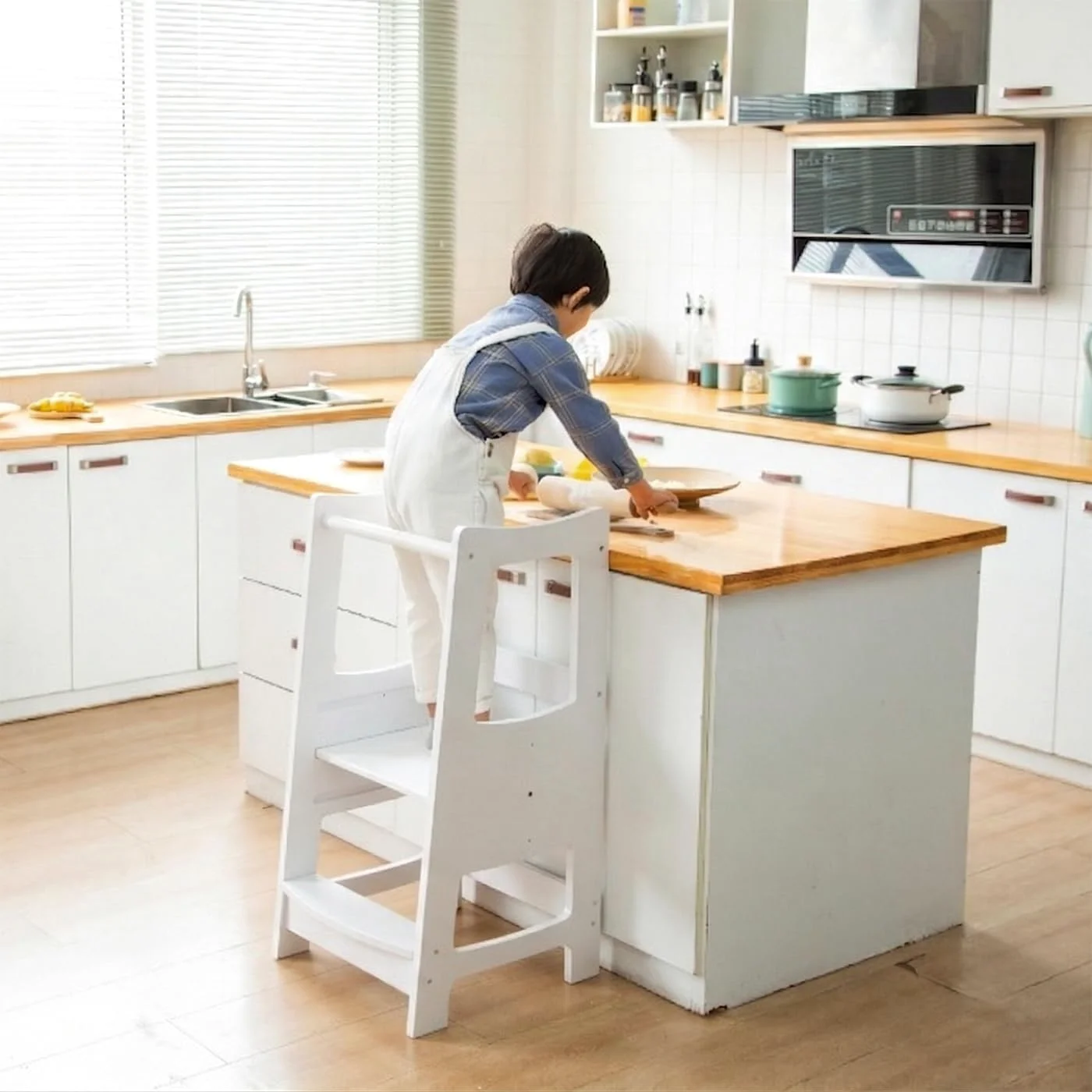
The first afternoon at the counter
The stool arrives, you slide it to the counter, and suddenly your toddler is right beside your chopping board. They were on the floor this morning. Now they are at your elbow.
Our stool puts a small child in reach of the counter in a single afternoon. The kitchen they arrive in takes longer to get ready. Before you even clip the platform into place, it helps to picture what your child will see and touch from up there. The floor world of toy boxes and low shelves is gone. Now the world is a strip of counter, bright objects, and the edge itself.
With the platform at 20 inches, an eighteen-month-old's chest comes to the edge of a 36 inch counter. Their eyes run along the surface. Their hands follow very quickly. Anything close enough to bat, pull, or drag now feels like it belongs to them. A spoon half over the edge is a target. A dish towel hanging down is a ladder. A cup with a handle looks made for gripping.
You do not have to fix everything at once. You do need to decide that the counter is now part of your child's play space, even when you are not ready for it. That choice sets the tone for what moves, what stays, and what work you actually do together once they are up there.
The new reach zone along the counter
A child standing on a 20 inch platform sees the counter as a wide, inviting runway. Anything on that runway can be touched, pushed, or pulled if it is within a short lean.
Think about three bands. Closest is the absolute edge, where small hands rest, tap, and drum. Next is the working band where you chop, butter, stir, and put plates down. Furthest is the back strip against the wall, where you keep things you do not constantly move. Most toddlers can reach the edge and working band easily, even at the lower platform settings. The back strip is more of a stretch, at least at first.
The main risks now fall inside that reach. Pan handles that used to point out over empty space are suddenly level with curious fingers. Kettle and toaster cables that cross the counter can be grabbed and tugged. A knife left near a board is no longer a quiet tool in your hand. It is a shiny object inside your child's zone. A mug of hot tea set down carelessly becomes something they can pull towards their chest.
Your job is to move anything hot, sharp, heavy, or spillable into the back strip or a cupboard before they step up. That sweep of the counter becomes a habit. You look once along the edge. You slide, turn, or unplug what now sits inside their reach. Then you invite them up to join you.
Handles, cords, and the hot strip
The area over the stove and its nearest stretch of counter now deserves its own name in your mind. Think of it as the hot strip. It holds the things that stay warm, get hot, or stay plugged in while you cook.
Pan handles are the first detail to change. Where you once pointed them out for your own comfort, you now turn them inward, so they sit over the burners rather than the edge. It can feel less natural at first. It quickly becomes automatic when you see a small hand tapping the front of the stove. Any empty pan cooling after use moves to a back burner or another counter with its handle turned away from the stool.
Cords invite pulling. Kettles, toasters, stand mixers, and small appliances all trail cables across the counter, and those cables are now at hand height. Shift appliances so their cords run away from your child's position, not across it. A kettle sitting beside the stove, with its cord tucked behind, gives far less to grab than one parked in front of the stool with a long loop of cable.
Hot drinks need a rule as firm as your stove habits. If there is a hot cup, it lives behind your cutting area or on another surface until it cools. No steaming mugs near the edge where your child is working. You clear that hot strip before you cook together. Then you keep it clear every time you lift them into place.
Under the sink and around the oven
Standing at the counter also changes what feels interesting below it. Doors that once sat above your child's eye level now sit at their shoulder, and the inside of the cabinet suddenly looks open for business.
Cleaning products under the sink are the first to move. Bottles your child never saw from the floor become brightly labeled toys as soon as they can lean, reach, and pull a door. Anything that can irritate skin, eyes, or mouths does better in a high cabinet or a closed bin in another room. If that is not possible, a child lock on the sink doors turns a temptation into a boring panel they pass by on the way up.
The oven gains new attention too. A glass door at chest height is more than a window now. It reflects their face, your movement, and any light from inside. A hand pressed to cool glass is fine. A hand pressed to hot glass is not. The safest habit is simple. If the oven is hot or heating, the stool waits in another part of the kitchen until you are done.
Even when the oven is off, the door can become a handle in your child's eyes. You may find them bracing a foot on the bottom edge to climb higher. That is one reason a rigid frame stool matters. It stays put when they climb, so you can move the stool away from the oven and know it will not fold under them or tip while you turn back to your cutting board.
Moving chemicals higher, adding simple latches, and treating the oven area as off limits during cooking all clear a safer circle around the spot where you plan to work together.
Where the stool stands and where it does not
Placement turns your stool from a general height boost into a specific work station. You choose where your child joins you, and that choice sets the boundaries of their new reach.
A clear stretch of counter away from the stove and oven makes the best base. You want room for a cutting board, a bowl, and a little mess without creeping toward the hot strip or the oven door. If your sink sits between the stove and a safer section of counter, consider placing the stool at the far side of the sink, not between sink and stove. That way splashes stay on one side and heat on the other.
The floor footprint of our stool is 16.3 by 17.7 inches. You need that clear on a flat, stable surface with enough space behind to climb in and out. A tight gap between an island and a wall can be tempting, but it can also trap you if you need to move quickly. A corner where two counters meet often feels cozy, yet it can also put your child in reach of twice as many drawers and appliances.
There are places the stool simply does not belong. Right in front of the stove, directly under hanging knives or heavy tools, or beside a tall trash can that can be tipped with a lean. The rigid frame gives you a stable base. It also means you decide where it lives most of the time. Pick a standard spot with good light, a safe view, and a clear path, and you turn that part of the counter into your shared kitchen bench.
Jobs for twos, threes, and fours
Once the space is set, the question shifts from what to remove to what to invite in. Work together is what a toddler steps up for. You can give them real tasks that match their size and attention.
At around two, jobs need to be simple, sensory, and close to the edge. You can slide a bowl of washed berries in front of them to move from one container to another. You can hand over a soft pastry brush to "paint" a little water on dough or a tray. They can pat dry clean lettuce leaves, press the button on a small battery-free gadget you steady, or sprinkle pre-measured toppings you pass into their hand.
By three, reach and control improve enough for slightly more directed tasks. You can set a small pile of bread pieces for them to arrange on a tray, spoon yogurt from one bowl to another, or stir a mixture you are also holding. They can help line up muffin cups, wash sturdy vegetables in a bowl at the counter, or press cookie cutters into soft dough you have rolled.
Four year olds often want the full job, not just the fun moment. You can let them spread soft butter with a blunt spreader on bread you hold, tear herbs into a bowl, or help sort ingredients into small dishes before cooking. They can wipe the counter with a damp cloth at the end, carry light, cool plates a short distance, and help you put away unbreakable items.
Describe these as "your jobs" rather than "helping." That language makes it clear that this spot on the counter is their place to work, with tools you hand over already checked for weight, shape, and reach.
The unasked climb and the rigid frame
There will be a day when you turn around and find your child already standing in the stool. You did not invite them. They climbed in because it is theirs and it was there.
This is the real test of how the stool fits your kitchen. A rigid frame that stays where it is put behaves the same way every time. It does not fold in on them or shift under their feet when they haul themselves up the rail. That predictability matters, because you cannot un-teach the discovery that they can climb into it alone. What you can shape is what happens next.
The first step is to treat the unasked climb as data. Your child has a new skill and a new habit. They will do this again. Instead of only reacting in the moment, adjust the environment for the assumption that they can reach the platform on their own. That may mean sliding the stool further from the stove when it is not in use, or keeping it under a specific stretch of counter you have already cleared.
You can also build a simple rule around it. If they climb in without you, the shared work does not start until you arrive and check the counter. You step in, sweep the reach zone again for hot, sharp, and heavy things, and then you either invite them to stay up with a task or ask them to climb down while you move the stool. Over time, they learn that the stool is not a general ladder to any part of the kitchen. It is the place where you work together once the space is ready.
A last pass before small feet step up
By the time the stool is part of daily life, the prep can feel as quick as washing your hands. It still helps to keep a short, concrete routine in mind before your child climbs in.
You can use this checklist as a final pass:
- Push pan handles toward the back of the stove and move hot pans away from the stool's side.
- Slide knives, graters, and other sharp tools to the back strip or into a drawer.
- Move hot drinks and hot dishes to a spot your child cannot reach from the platform.
- Tuck or reroute appliance cords so there is nothing to grab and pull near the edge.
- Close or latch the under-sink cabinet and any drawer that holds cleaners or sharp tools.
- Shift the stool to its usual "work" section of counter, away from the stove and oven.
- Place one clear job in front of where your child will stand, so they see their task right away.
Once that quick loop is done, you can call them over. They climb in, you stand beside them, and the counter is no longer a mystery zone full of hazards. It is a workspace you have already shaped for the two of you to share.
Nothing here is a substitute for watching a child in a kitchen.
Three pieces, six finishes
Every finish in the EGREE selection sits behind this button, with the price from our last update against each one.