Home › Guides › Will a potty seat fit your toilet?
Look at the rim
Will a potty seat fit your toilet?
Round, U-shaped, elongated, square: three of those take a child seat and one does not. Here is how to tell which one is in your bathroom.
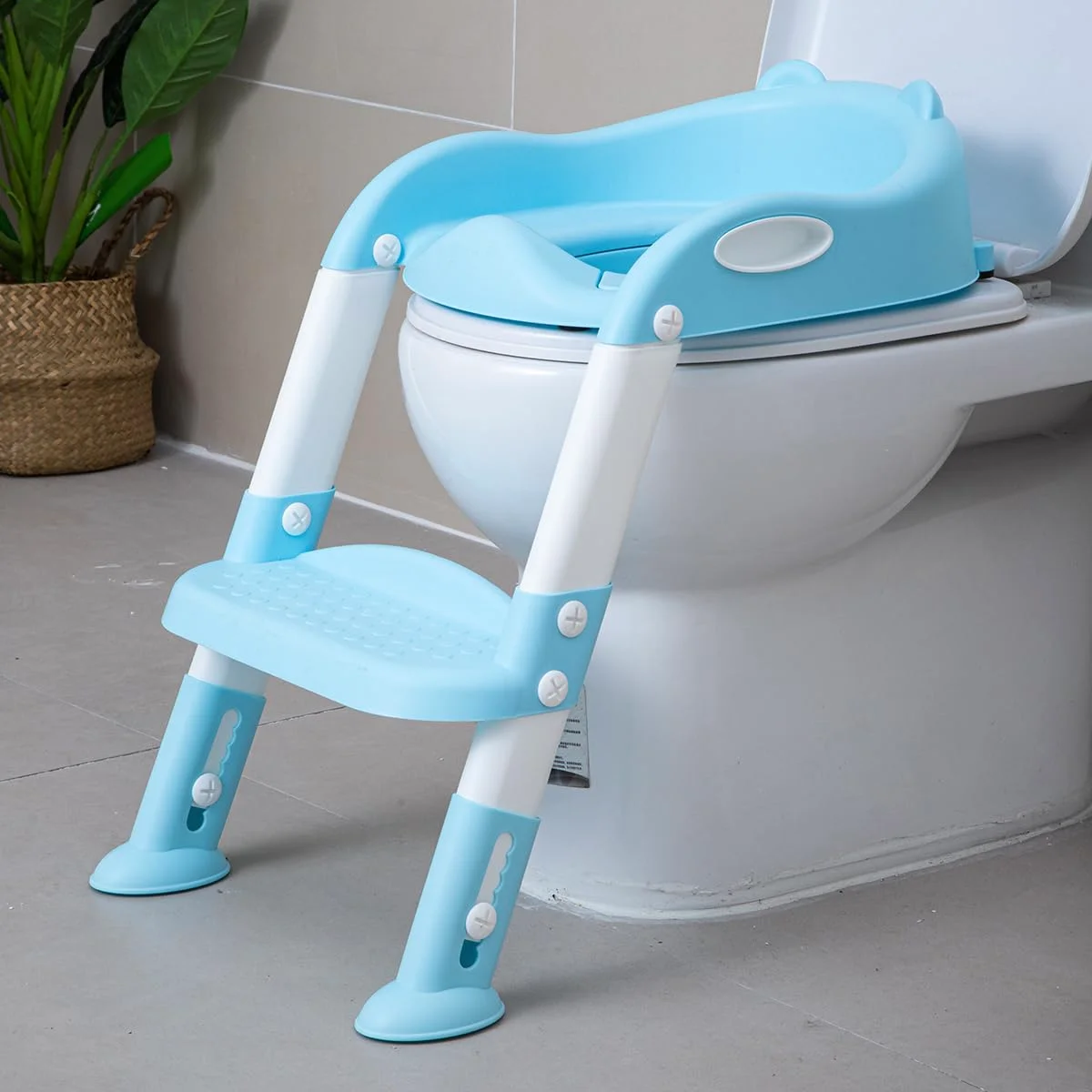
Start with the rim, because that cannot change
A child seat with a ladder can only work if it sits safely on the toilet rim you already have. The bowl can be tall or low, the floor can be busy or clear, but the rim shape stays the same. That is where you need to start looking.
Our potty training seat sits directly on the rim of a full-size toilet and grips it with rubber pads under the seat. Those pads need a continuous curve to hold onto. They are shaped for round, U-shaped, and elongated rims. They do not sit safely on a square rim.
If the rim is square, no adjustment on the ladder will fix that. The seat will not fit that toilet. In every other case, height and space can be worked around, as long as the rim itself is not a sharp cornered rectangle.
Stand over the toilet and look straight down at the inner opening. If the curve keeps flowing from back to front without sharp 90-degree turns, you are in the right family of shapes. The seat can follow that curve and spread the child’s weight across it.
The potty training seat itself is 14.6 by 13.4 inches when assembled, and 19.6 inches tall from floor to top. Those measurements sit around the bowl, not inside it. The part that matters most in this first check is still the outline of the rim.
Once you know the rim is not square, you can move on to how it is curved, how long it is front to back, and what that means for the way your child will sit.
Round, elongated, U-shaped, square: what you see when you look down
Round, U-shaped, and elongated rims all work with our potty seat. Square rims do not. That list can sound abstract, so it helps to name what you see when you stand over your own toilet.
A round rim looks compact. From above, the inner opening feels close to a circle. The distance from the front of the bowl to the bolts at the back is short. If you imagine a large dinner plate over the opening and it almost covers it, you are probably looking at a round bowl.
An elongated rim looks stretched toward the front. The inner opening is more of an oval, reaching out in front of the tank. That extra length gives adults more sitting room. Our seat follows that longer curve and still rests on the rim, as long as the corners stay rounded rather than square.
A U-shaped rim has a flat or slightly squared back section near the tank and a smoother curve at the front. The inner opening looks like a wide U. The important part is that the front and sides still create a continuous rounded path for the child seat to sit on.
A square rim shows clear, sharp corners when you look straight down. The front edge looks like a line, not an arc. The opening reads as a rectangle with clipped corners, not a circle or oval. Our potty training seat does not fit that shape, because its underside and rubber pads are built around curves.
Once you name the shape you have, you can be confident you are not fighting corners with a product meant for curves.
Ladder height, toilet height, and where your child’s feet land
After the rim shape, the next fixed piece in your bathroom is how high the bowl sits from the floor. Our potty seat ladder has six height settings, and together they cover standard, comfort, and ADA-height toilets. That range means the footboard can meet your child where they are, instead of leaving feet dangling.
Standard toilets are the lower end of what you see in most homes. Comfort and ADA-height toilets sit higher off the floor. A higher bowl can look like a barrier to a small child. The ladder turns that height into a climb they can manage step by step.
At every setting, the non-slip footboard gives a flat place for the child to plant both feet. Handrails on both sides give something solid to hold as they climb and turn. With the highest ladder setting on a tall toilet, a three-year-old can still climb until their hips are level with the seat, then pivot to sit with control.
The seat and ladder together are 19.6 inches tall at full assembly, though the exact footboard height depends on the rung you choose. With six settings to choose from, you can match the footboard to your child’s leg length and the bowl height. That way the knees bend in a natural way, and the child is not stretching or jumping from the last step.
When the legs, hips, and hands feel supported, your child can focus less on the climb and more on the part that matters to them.
The floor in front of the bowl, and why clear space matters
Even if the rim shape and height work, the floor in front of the toilet can still decide whether the ladder sits flat. The base of our potty training seat needs a stable patch of floor right in front of the bowl. That is where the child will step first and where the non-slip footboard does its job.
Look down at the space where adult feet land when someone stands at the toilet. Any thick bathmat, heating grate, or raised threshold there can tilt or rock the ladder. If the floor slopes sharply, the base may not sit even. The seat itself weighs 3.35 lb and is made of PP plastic, which means it does not have the heavy mass of a porcelain fixture to force itself level. It relies on a reasonably flat surface.
You do not have to remove every rug from the bathroom. You may only need to shift one mat a few inches so the ladder feet rest directly on hard flooring. If there is a cabinet door that swings into that space, check how far it opens before it hits the side of the ladder. The assembled footprint is 14.6 by 13.4 inches, which gives you a sense of how much floor it occupies.
Once the ladder is in place, stand where your child will stand and step on the footboard. It should feel solid, with no wobble when you move your weight forward and back. That simple trial run shows you what your child will feel under their own feet.
Folding flat in a shared bathroom
In many homes the bathroom is shared between children and adults, and sometimes with guests. A piece of equipment that stands in the way all day quickly becomes something everyone steps around. Our potty training seat folds flat, which helps you use that shared space more flexibly.
When it is open, the ladder and seat form a single unit that hooks over the rim and rests on the floor. When you fold it, the ladder comes up toward the seat so the whole piece becomes a slim panel. At 14.6 by 13.4 inches, and 19.6 inches tall, that folded shape can slide beside a vanity, stand behind a door, or rest between the toilet and a wall, as long as you leave it somewhere a child can reach with you nearby.
The cushion on the seat lifts out, which is mostly about cleaning, but also makes it easier to keep the surface dry before you tuck the seat away. Rubber pads under the seat keep the plastic from marking the porcelain while it is in use. They also mean you are not scraping hard plastic over the rim when you put it on and take it off several times a day.
Think about your routine. If mornings are busy, you might leave the seat set up until everyone is out of the house, then fold it and stand it out of the way for the rest of the day. The lighter weight, 3.35 lb, keeps that fold-and-move step from becoming a chore for you.
When children are ready, and what equipment cannot decide
The right fit on your toilet does not tell you whether your child is ready to use it. The American Academy of Pediatrics notes that in the United States, toilet training usually begins between two and three years of age. Most children are trained by four. That is a wide range, because the signs of readiness live in the child, not in the bathroom.
The Academy points to several things you can watch for in your child. Staying dry for at least two hours at a time. Showing some clear signal before going, such as a look, a pause, or a word. Following a simple instruction. Walking to the bathroom and helping to undress. Disliking a wet diaper. Asking to use the toilet. Asking for underwear.
You can have the right seat, fitted safely to the right rim, and still choose to wait until those signs appear. A ladder with handrails and a non-slip footboard can make the mechanics of climbing and sitting more manageable, but it does not make a child ready before their body and mind are.
Keeping that difference in view can take some pressure off both of you. The equipment is there to respond when the signs line up, not to pull them forward. When you see your child staying dry longer, pointing to the bathroom, or asking to wear underwear, having a seat that already fits your toilet means you can say yes to that interest without also solving a measuring puzzle.
A last check, and what to do next
By the time you reach this point, the pieces in your bathroom should be clear in your mind. The rim is curved and not square. The height of the bowl is within the range covered by our six ladder settings. The floor in front of the toilet gives the ladder a stable place to stand. Your storage plan for a folded seat makes sense with the way your household uses the bathroom.
Before you act, it can help to walk through the steps your child will take. Stand where they will stand. Imagine a small hand on each side handrail and small feet on the non-slip footboard. At full use, the seat is rated to 165 lb, so you know it is built to take far more weight than your child will put on it. That rating gives you context as you picture the climb.
If everything lines up, you can go ahead knowing the physical fit is on your side. The child’s readiness will follow its own pace, guided by the signs the American Academy of Pediatrics describes. You cannot set a date on those. You can, however, get the hardware decision out of the way.
To finish, take a moment in the bathroom with the tape measure and your eyes. Then follow a simple checklist:
- Look straight down and confirm the rim is round, U-shaped, or elongated, not square.
- Check there is clear, flat floor in front of the bowl for the ladder base.
- Picture where you will store the folded seat so adults can still move freely.
- Watch your child over the next days for the Academy’s readiness signs and match your timing to them.
Those steps leave you with a toilet that can welcome a child safely when they are ready to climb.
When to start toilet training is a question about your child, and it is one for your pediatrician rather than for a furniture catalogue.
Three pieces, six finishes
Every finish in the EGREE line-up sits behind this button, with the price from our last update against each one.