Home › Guides › What age is a learning tower for, and which platform height?
Which step, when
What age is a learning tower for, and which platform height?
Eighteen months to five years is a long time for one piece of furniture. The platform is what makes it possible, and here is which setting belongs to which year.
Is eighteen months too early
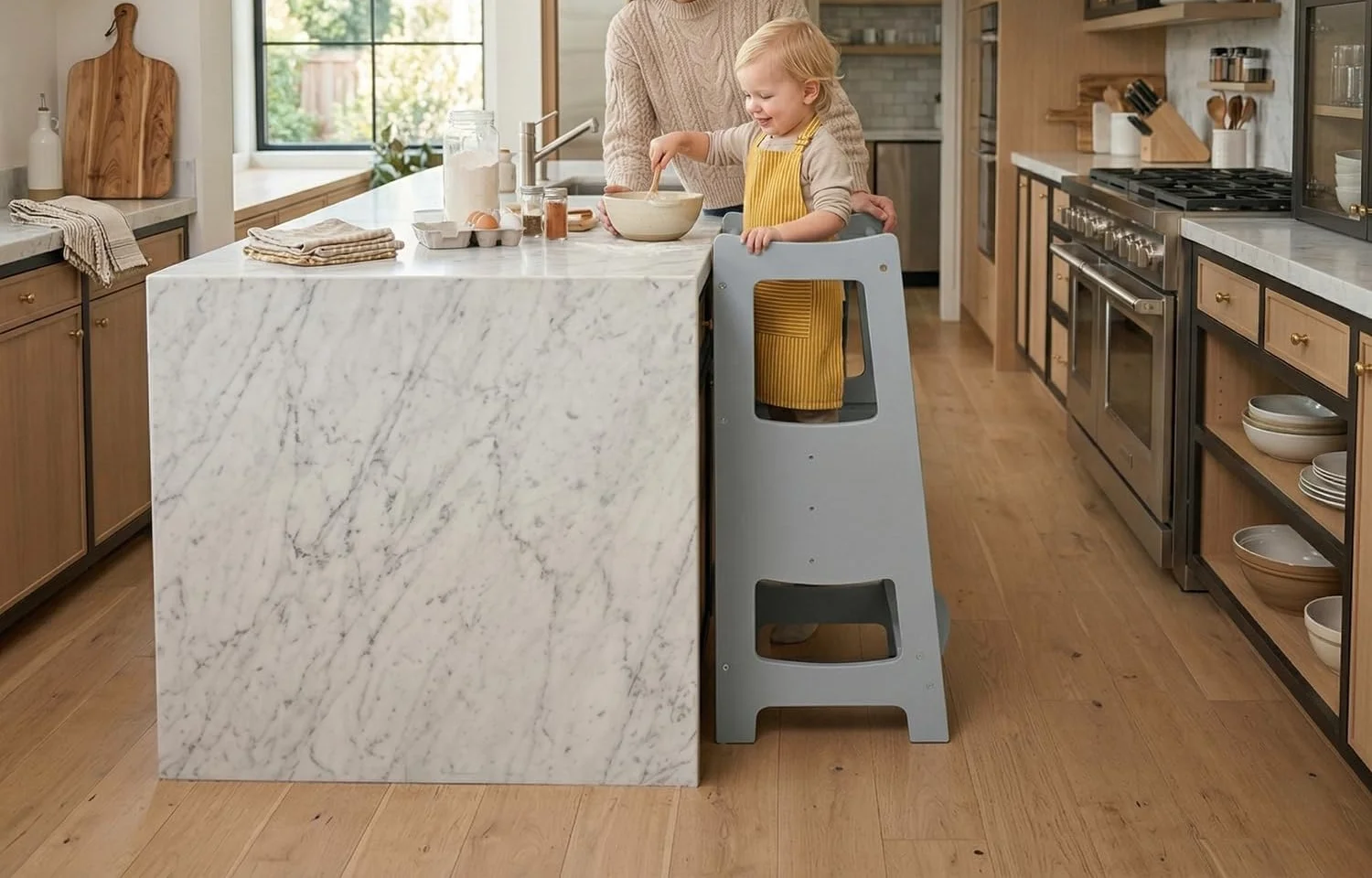
An eighteen‑month‑old can use a learning tower if you stay close, treat it as furniture, and pick the right platform height. The rating on our step stool starts at 18 months and runs through the fifth birthday, so your child is right at the beginning of the range. The question is not only age, though. It is how steady that particular child is on their feet, and how willing you are to stand beside them instead of across the room.
Our platform adjusts to 20, 16, or 12 inches from the floor. For a new user, the highest setting usually makes the most sense. A standard kitchen counter is about 36 inches tall. At the top setting the platform is 20 inches, which brings an eighteen‑month‑old's chest to the edge of a 36‑inch counter. That gives room for their hands and whatever you hand them, without their face level with every utensil and glass.
The frame stands 34.6 inches tall, with a rail on all four sides of the platform. A child who has just begun to climb often still uses two hands for balance. The rail gives them something to touch and lean against while they test their reach along the counter. Early on, that might mean laying out a single bowl or spoon where their hands naturally land, instead of spreading activities across the full run of the counter.
You know where your child is curious and confident, and where they are still wobbly. Start with short sessions at the high setting, stay within arm’s reach, and treat the new height as you would any new tool. Watch first. Then add more time, and more that they can do.
How the 20 inch setting works in your kitchen
The 20 inch platform height usually suits the youngest children who are ready for a tower. On this setting, most toddlers do not have to climb far, which keeps the first few uses straightforward. The total footprint on the floor is 16.3 by 17.7 inches, so the tower occupies about the space of a small kitchen stool, but it feels different to the child. They are enclosed by the frame and rail once they are up.
At a 36 inch kitchen counter, the 20 inch setting places a small child low enough that their hands are the main thing reaching the work surface. Their core stays inside the frame. That often feels less exposed than standing on a flat household step pushed against the cabinets, where there is nothing on the sides and nothing at the back. You still need to move hot pans and sharp tools out of reach. You simply have a little more predictability about where the child’s body will be.
A bathroom vanity is often nearer 32 inches, so the same platform height can bring more of the upper body level with the edge. That can work well for supervised handwashing or teeth brushing, as long as you remember that sinks are wet and slippery. The rigid frame does not fold, which helps keep the structure consistent every time you place it in front of a counter or vanity.
For the first months of use, many families keep the tower in one familiar spot. You can test how your child climbs, where they place their hands, and how long they like to stay before they get tired. Once the route up and down becomes routine, you can decide whether to introduce other rooms.
Moving down to 16 inches as your child grows
The middle setting at 16 inches usually suits the long middle stretch from toddlerhood into preschool years. Children grow quickly through this period, and their relationship to the counter changes with that height. On the lower platform, a taller child gains a wider view of the surface without feeling boxed in at shoulder level.
A four inch change in platform height can sound small. In practice, you may notice that your child now sees deeper into mixing bowls, reaches farther across a cutting board, or can turn slightly without their hips touching the rail. At this stage, many children start to move with more confidence, climbing in and out without asking for a hand every time. The rail on all four sides still defines their space, but they rely on it less for constant support and more as a boundary.
The 150 lb rating on the stool means the frame is built to hold the weight of a typical preschooler with room to spare. That does not mean you hand over the kitchen. It does mean the structure is sized for everyday climbing, leaning, and shifting of weight that come with more active children. On the 16 inch setting, you can often step half a pace back, still nearby, while your child pours, wipes, or pushes ingredients toward you.
As height and reach increase, so does access to drawers, cords, and objects that once felt far away. Before you move the platform down for a bigger child, it helps to stand where they will stand and see what comes into reach. Adjust what lives on the counter, and which cabinet doors the tower can approach, before their curiosity does the same work more quickly.
Using the 12 inch setting for older preschoolers
By the time a child is closer to five, the lowest platform setting at 12 inches often matches their size better. On this height, a taller preschooler can see most of the counter surface and handle objects without their elbows being held up by the rail. Their legs are longer now, so the climb up and down is still short, but not cramped.
At this stage, some children start to take more responsibility for climbing in independently. The tower’s 16.3 by 17.7 inch footprint stays the same, and the 34.6 inch frame height still gives a clear boundary. The difference is that much more of the child is visible above the rail. They can turn, twist, and reach across the counter, sometimes to areas you did not expect them to notice. This is often the moment to revisit what lives near the edge of the stove, which appliances stay plugged in, and which drawers they can now open from this higher vantage point.
The lowest setting can also feel more natural in front of a bathroom vanity around 32 inches tall, especially if your child is tall for their age. They can reach the faucet and mirror without needing to lean heavily on the rail. Because the frame is rigid and does not fold, it remains a stable, predictable structure in each room, even as the way your child uses it matures.
Adjusting down to 12 inches is as simple as moving four countersunk screws into the lowest set of pre‑drilled holes. You can do this when you notice your child bending their knees to fit, or having to duck slightly under the rail to step out. Watch how they move for a week, then choose the moment when the lower level will feel like an upgrade rather than a surprise.
What the rail is for, and what it is not
The rail around the platform is there to give your child a defined space, and something solid under their hands. On all four sides, the wood forms a frame around the 20, 16, or 12 inch platform, so a child who likes to hold on has material in reach wherever they turn. Early users often keep one hand on the side or front rail while the other hand works on the counter. That small contact can make a big difference to how steady they feel.
The rail also reminds a more active child where the edge of their zone is. It turns the top into a kind of standing room instead of an open step. That matters on busy days, when you are cooking, answering a question from another room, and trying to keep track of movement at your hip. You can trust that the basic shape stays the same every day, because the frame is rigid, not folding or telescoping.
There are limits to what the rail can do. It does not replace your supervision, or make it safe to turn your back on a climbing child. It is not a gate that locks them in, or a harness that keeps them upright. Children can still kneel, twist, or attempt to climb higher than the platform, especially as their confidence grows. The rail simply lowers the chance that a small sideways shift becomes an immediate step into empty space.
Over months and years, you may notice your child using the rail differently. First as a handle, then as a casual touch point, then almost not at all. Keep watching how they interact with it. If you see them leaning heavily on one side or using it as a ladder, that is your cue to revisit the platform height, the placement in the room, or the expectations you set before they climb.
How a learning tower differs from a household step
A learning tower has a different job than an ordinary household step. A typical step or small stool often has one flat surface and open sides. It is designed to help an adult briefly reach a high shelf or bulb. The learning tower shape, called a learning tower in Montessori circles, surrounds the child with a frame and rail once they are on the platform. It is meant for longer stretches of standing at counter height.
Our tower uses solid wood for this frame, which gives the structure mass and a steady feeling under little feet. The platform adjusts to three fixed heights, and moving between them uses four countersunk screws in pre‑drilled holes. That is slower than a folding step that flips open, but it also means the position does not drift. Every time your child climbs, the platform is in the same place you set it.
The size and rating reflect the different purpose. Assembled, the frame is 34.6 inches tall and rated to carry 150 lb, which allows space and capacity for children from 18 months through 5 years. A simple household step might tuck more easily into a closet or fold flat. Our frame does not fold, and it occupies a clear 16.3 by 17.7 inch footprint on the floor. In return, your child gets a stable standing room that can become a familiar part of daily routines.
The finishes also speak to regular use. Natural and white versions weigh about 19 lb each. The grey option weighs about 12.5 lb and is finished with a water‑resistant, wipe‑clean surface. That can matter in a kitchen where spills happen and cleanup needs to be quick. Picture where you would place a household step, then picture a piece of furniture that will stay there more often and carry a moving, growing child.
Setting up your kitchen so the tower works for you
A learning tower changes how a child reaches the kitchen. The room needs small changes to match. Before the first use, it helps to decide exactly where the tower will usually stand. Many families choose a spot along the counter that is away from the stove, away from sharp drawer contents, and near a stretch of clear surface where you can place safe items. Once you find that place, you can start to think of it as the child’s station.
The tower’s footprint is about 16.3 by 17.7 inches. That size fits in most walkways, but you still need space to stand beside it, open a cabinet, or work at the sink. Try parking it where you think it should go, then walk the path you use on a weeknight. If you find yourself bumping into the frame or needing to reach over your child to get to the fridge, adjust the plan before they form a habit.
What lives on the counter matters just as much. Move knives, graters, glass storage, and hot appliances farther from the tower’s usual reach. Place bowls, sturdy utensils, and ingredients for simple tasks near where your child will stand. The same applies to nearby drawers and cabinets. Children use the platform to reach not only up, but also out, so a drawer that was once harmless can suddenly become the source of heavy lids or tools.
The bathroom benefits from a similar review, especially if you roll the tower between rooms. At a 32 inch vanity, think through where toothbrushes, soap, and medications sit. Shift breakable or risky items before the first climb.
When you have your spot and your setup, you can introduce the tower slowly. Invite your child to climb with you close by, keep the first activity simple, and end the session before they get restless. Each time you move the platform to a new height, make a small loop through the kitchen again. Then you and your child can grow into the next stage together.
A quick checklist before your child climbs
- Choose a main spot for the tower in the kitchen, away from the stove and heavy drawers.
- Pick a starting height, usually 20 inches for an eighteen‑month‑old, and assemble the platform with all four screws tight.
- Stand on the floor where your child will stand on the platform and see what comes within their reach.
- Clear knives, glass, cords, and hot appliances from that zone, and bring safe items closer.
- Walk your usual cooking path with the tower in place and adjust so you can move around it without squeezing.
- Talk through simple rules with your child before they climb, such as feet staying on the platform and waiting for your help to get down.
- Stay beside the tower during early sessions, and shorten the time if you see your child getting tired or fidgety.
- Revisit platform height and room setup every few months as your child grows, reaches farther, and uses the rail differently.
A tower puts a child at counter height. What is on the counter is still the thing that decides whether that is safe.
Three pieces, six finishes
Every finish in the EGREE range sits behind this button, with the price from our last update against each one.